Free Resources to Help You Understand Your Anxiety Patterns

These resources are designed to help you slow down, notice what’s actually driving your anxiety and overthinking, and make sense of the patterns running in the background. They’re not quick fixes or productivity hacks, just practical tools to help you build awareness before trying to change anything.
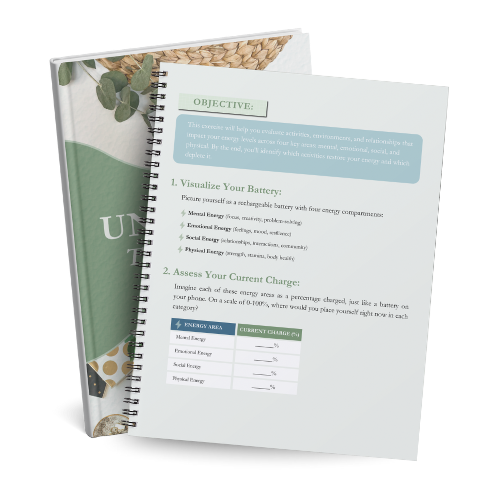
Energy Audit
The first exercise from UNPACKED: The Workbook
The Energy Audit is a guided self-assessment designed to help you understand where your mental, emotional, and nervous-system energy is actually going. Many people feel exhausted not because they’re doing too much—but because their energy is being quietly drained by patterns they’ve never been taught to notice.
This audit helps you slow down and observe before trying to change anything.
Inside the Energy Audit, you’ll:
Identify hidden energy drains like overthinking, hypervigilance, people-pleasing, and emotional over-functioning
Begin connecting present-day exhaustion to long-standing survival patterns
Understand why rest alone hasn’t fixed the fatigue
Notice where your nervous system is staying “on” even when nothing is wrong
Create clarity about what’s costing you the most energy—without judgment or self-blame
This is not a productivity tool or a mindset worksheet. It’s an awareness-based starting point designed to help you see what’s been running in the background for years.
How to Stop Overthinking
A therapist-created set of tools for mental overload and rumination
The Overthinking Bundle is a curated collection of tools designed to help you interrupt rumination, reduce mental overload, and create more space between your thoughts and your nervous system. It’s built for people who are highly analytical, self-aware, and still feel stuck in their own head.
Rather than asking you to “think positive” or stop worrying, this bundle focuses on understanding how overthinking works—and how to step out of it.
Inside the Overthinking Bundle, you’ll:
Learn why your mind defaults to rumination, scanning, and worst-case thinking
Practice tools that help slow racing thoughts without forcing calm
Develop more flexibility between thoughts, emotions, and reactions
Reduce mental fatigue caused by constant internal monitoring
Build awareness of the anxiety patterns that keep you looping
These tools are practical, structured, and designed to be used in real life, not just read once and forgotten.